


Poem
by Thomas McGrath
How could I have come so far?
(And always on such dark trails?)
I must have traveled by the light
Shining from the faces of all those I have loved.
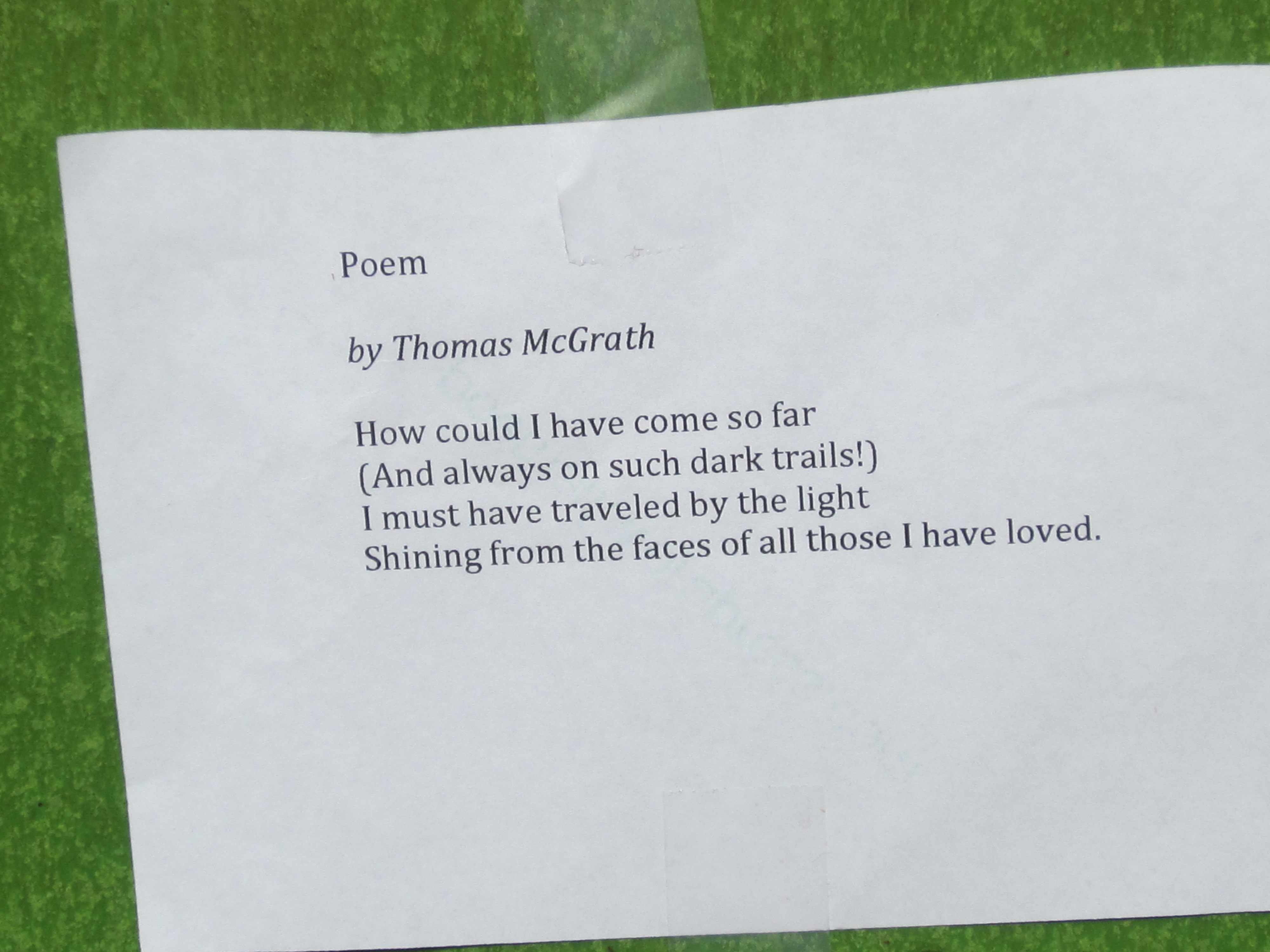
If I were skilled in the art of micrographia, I would copy this poem on vellum in the tiniest of scripts, with flourishes visible only by magnifying glass, and put it in a silver locket I would wear around my neck. There’s an elegance and a goodness in “Poem” that I want to keep close and display as if they belonged to me. The elegance comes from the poem’s brevity—a lifetime in four lines—and its symmetry. The first two lines, seven syllables each, pose a question. The second question modifies the first, just as the answering phrase in the third line is modified by the phrase that follows.
The way McGrath chooses to measure his life speaks to his goodness. The poem begins mid-thought, as if McGrath is standing atop a hill he’s climbed, catching his breath and surveying his steps. Musing over the dark trails he’s passed through, he could have asked any number of questions: Why did I have to go through all that crap? or Why didn’t I get farther, do better? or How much farther do I have to go? Instead he marvels at his progress:
How could I have come so far?
His answer is rooted in humility. As with the question, the nature of his answer is best seen by what it is not. He could credit his own grit and determination. Or he could credit the people who have cared for him, who have loved him. Nothing wrong with either approach. The latter can be a wonderful exercise in gratitude. But it can also turn into self-congratulation. In dark moments of runaway hypochondria, from which I suffer occasionally, I imagine my funeral. I think how sad everyone who loves me will be. Mewling and licking my endearing qualities, I construct eulogies, tributes and photo boards to prove how loveworthy I am.
What grabs me is that McGrath looks towards those he has loved. Counting the people he has loved rather than the people who have loved him increases exponentially the length of the human luminaria he describes:
I must have traveled by the light
Shining from the faces of all those I have loved.
Not only does a good and kindly heart love many more than a sour or self-centered one; a good and kindly heart can love just about anyone. The decision to love transforms the beloved, or to use the image in “Poem,” lights a wick that sets them aglow.
The deep, abiding love for friends and family provides the brightest light. But our luminaria can also include the glancing love we feel for strangers or for those who may not notice us at all: the grandmother I saw the other day in the rain cooing “wishy wishy woo” to her granddaughter in the grocery cart; novelist Penelope Fitzgerald and essayist Anne Fadimann; the slow-stepping woman in my neighborhood who walks her old greyhounds twice a day; the possibly autistic deli owner who tries very hard to converse with customers; giggly Miss Clement, my high school English teacher who crossed her arms on top of a bosom that fell below her waist; the tall and unbathed brother and sister who danced so joyfully at Saturday night ceilis in Baltimore long ago. And so on.


